


News

News
Choosing the right pulp molding machine isn't just about picking the lowest price — it starts with getting the production capacity right. A machine that's too small will bottleneck your entire operation; a line that's oversized will sit idle and waste capital. This guide walks you through how to calculate your real output needs and match them to the right machine configuration, so you can buy with confidence and avoid costly mismatches.

Production capacity in a molded pulp line is driven by three interacting factors: the forming machine's cycle time, the number of cavities per mold, and the number of working stations. Understanding these — and how they combine — is the first step toward sizing your line correctly.
For a deeper look at how each subsystem works, browse the full range of pulp molding equipment on our site. The key is that "capacity" is not a single number on a spec sheet — it's the product of several variables working together.
Before you talk to any supplier, do the math yourself. Start with your sales forecast and work backward to the machine rating you actually need.
Different products use molds with different cavity counts. A standard egg tray mold might hold 30 eggs, while a cup tray or fruit tray mold could hold 6, 12, or 24 cavities. Each cavity produces one finished piece per cycle. More cavities per mold means more pieces per cycle — but it also requires a larger forming machine and more vacuum capacity.
Cycle time includes forming, transfer, and (in wet-press lines) hot pressing. Typical dry-press egg tray lines run at 8–15 seconds per cycle, while wet-press tableware lines can take 15–25 seconds per cycle due to the additional hot press stage. Add 10–15% for machine downtime, mold changes, and operator breaks to get a realistic figure.
Use this simple formula: Hourly Output = (Cavities × 3600) ÷ Cycle Time in Seconds × 0.85. The 0.85 factor accounts for realistic running efficiency. For example, a 30-cavity egg tray mold at a 10-second cycle gives (30 × 3600) ÷ 10 × 0.85 ≈ 9,180 pieces per hour.
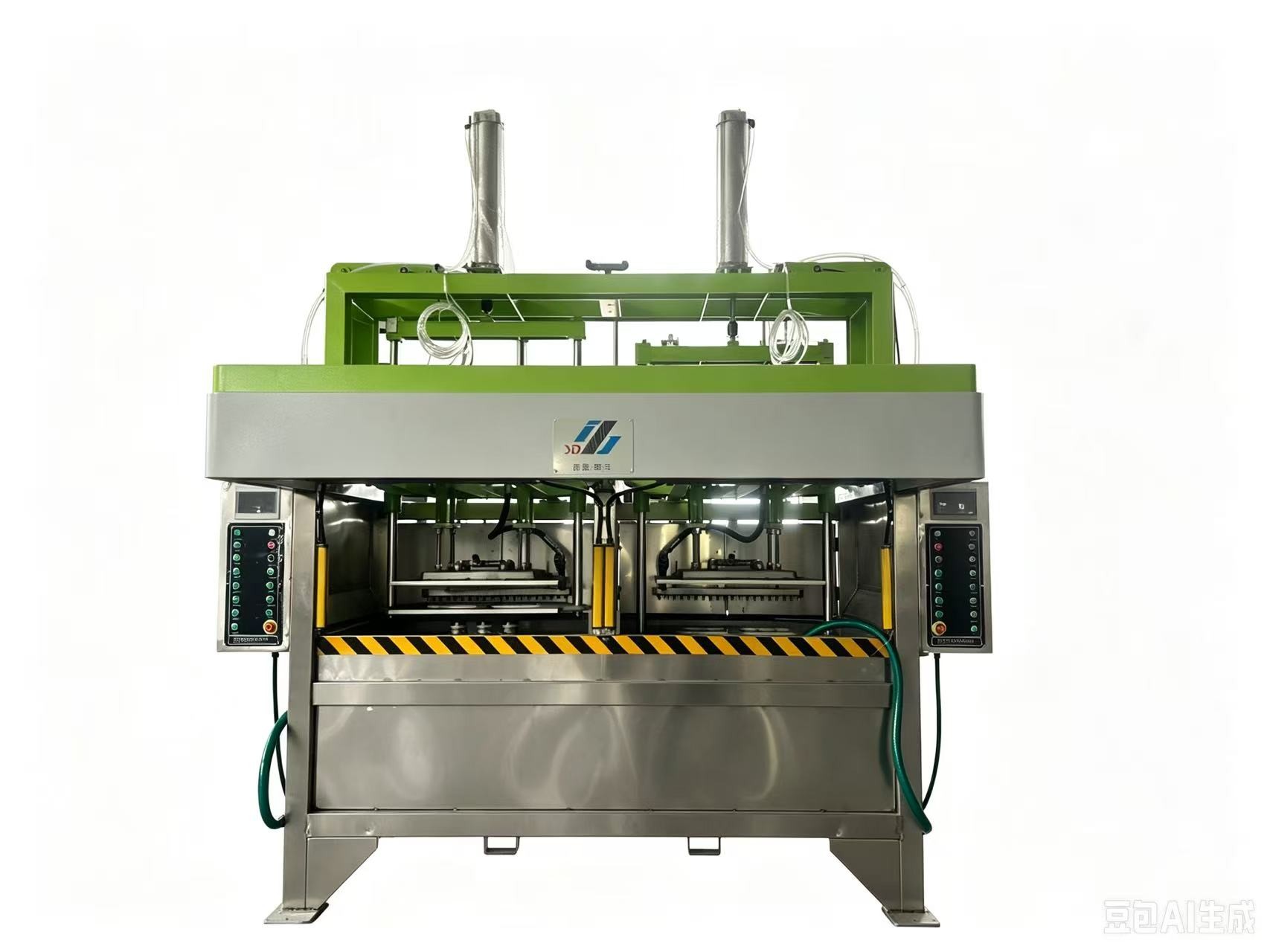
Based on decades of supplying lines worldwide, we see buyers grouped into three common capacity tiers. Matching your output target to the right tier helps you compare apples-to-apples across suppliers.
This tier is ideal for startups, pilot projects, or regional packaging suppliers adding a molded pulp line alongside existing operations. A single-cylinder, single-station forming machine paired with a small drying line is usually sufficient. Capital investment is lower, and labor requirements are modest — typically 2–3 operators per shift.
At this volume, buyers typically need a dual-cylinder, dual-station molding machine that runs two molds in parallel, effectively doubling throughput without doubling footprint. This tier is the sweet spot for commercial egg tray producers and medium-sized food packaging converters serving regional markets.
High-volume operations — such as national egg producers or export-focused packaging converters — need fully automated lines with multi-station rotary formers, multi-tier drying ovens, and automatic stacking and packing. The one-water-one-heat automaton configuration is designed for this tier, where continuous 24-hour operation is the norm.
Even if you've sized the forming machine perfectly, three other bottlenecks can quietly halve your actual output.
The forming machine is only as fast as the drying oven behind it. If your dryer can only process 5,000 pieces per hour but your former spits out 8,000, you'll be stacking wet parts on the floor. Always size the drying line to match — or slightly exceed — the forming machine's output.
Manual loading, unloading, and packing can become the bottleneck at higher volumes. Budget for automated stacking, conveying, and (for high-volume lines) robotic packaging from day one — retrofitting later is far more expensive.
An under-sized pulping system means the forming machine waits for slurry. Make sure your crusher, deflaker, and pulping tanks are rated to feed your line at full capacity, with 20% spare headroom.

After helping hundreds of buyers spec their lines, we see the same mistakes repeat:
1. Sizing for peak demand only. If you buy exactly for your highest-month forecast, you have no headroom for growth. Add 20–30% to your target output.
2. Comparing machine-only specs, not complete lines. A cheap former paired with an undersized dryer delivers less real output than a slightly more expensive but properly balanced line.
3. Ignoring product changeover time. If you plan to produce multiple tray sizes, factor in mold change frequency — which effectively reduces your net capacity.
Every operation is different. The right capacity depends on your product mix, your market, your labor setup, and your growth plans. Rather than buying off a generic spec sheet, talk to us about your specific requirements. Our engineers can review your output target, product range, and site layout to recommend the exact machine configuration and drying line size for your project.
Visit our contact page to send us your product list and monthly volume target — we'll come back with a line configuration, estimated output, and a quotation within 2–3 working days. You can also browse our full product range to see the types of molded pulp packaging our machines produce.


 +86 189 2452 1063
 s-dzhiyuan@163.com
 18924521063



Online Message

Follow Us


Top
